The
Roman Catholic Church and Quebec
Claude
Bélanger,
Department of History,
Marianopolis College
Without
a doubt, the social institution that exercised the greatest influence, and had
the most impact on Quebec, was the Roman Catholic Church, simply referred to as the
Church for the most part in Quebec as a recognition of the unique place it occupied
in the history of the province and the important role that it came to play.
For quite sometime, in
the English speaking literature on Quebec, the most common image was that of a
priest-ridden province whose clergy not only exercised a disproportionate
amount of influence on a people said to be «fairly simple» but, as well, by keeping them in
relative ignorance, and isolating them from the rest of the continent, contributed
to the increasing economic inferiority that came to mark the province and remained
severe until the recent past. While this image, like most, contained a grain of truth
it largely amounted to misrepresentation. [See for example: Charles LINDSAY, Rome in Canada: The Struggle for Supremacy Over the Civil Authority, Toronto, Lovell Brothers, 1877, 398p. and Walter Alexander RIDDELL, The Rise of Ecclesiastical Control in Quebec, New York, Columbia University Press, 1916, 191p.]
Strangely
enough, this negative image of the role of the Church was also echoed by the new
social scientists that were trained in Quebec in the period of
the Quiet Revolution. This group, which sought the modernization of Quebec and
championed the cause of radical change, condemned widely the obscurantisme that had characterized Quebec in the period before the 1960's and blamed the Church
for much of the ills they believed afflicted Quebec in the contemporary era.
Both
groups had two things in common: they tended to view the role of the Catholic
Church in Quebec history in fairly negative terms and both argued as if the Church
had always be dominant in the province. While the former is a matter of evaluation
that is the subject of debate, the latter is increasingly nuanced by new findings. In looking at the history
of the role of the Catholic Church in Quebec it is possible to distinguish seven
different periods. These will be examined briefly below, although far more attention
will be devoted to the period of 1791-1960 than other periods.
1.
1608-1663 The Theocratic Period
This
is the period of the beginning of the colony of New France; it is frequently called
the mystic or theocratic in recognition of the dominant
role that the Church played in this period of the history of the colony. It corresponds
to a period of intense religious activity in France as well as political instability
and upheaval. These were reflected in Canada. The Church was very active in the
pursuit of the conversion of Amerindians and wished to establish a colony of Europeans
to serve as a model Christian community to which they could make reference in
their work with the native people. In the absence of appropriate state institutions
which will have to await the establishment of Royal Government in 1663, the Church
not only assumed the functions ordinarily devoted to it in Catholic France but,
as well, those attributed to the state properly. Thus, the Church was involved
in all of the socio-educational services at that time, played a major role in
the exploration of the continent, was involved in the government of the colony,
attracted a good many of the immigrants, founded missions and cities (Ville Marie
for example), influenced in a variety of ways the economy of the colony and was
primarily in charge of relations with Amerindians. In most respects, in the absence
of a state, the Church became the state, if we understand the state's primary
functions to be to regulate the life of individuals and to provide community services. 2. 1663-1760:
The Gallican period
Civil
government was firmly established by Royal Edict in 1663 (Royal Government) and
with it Gallicanism reached the shores of the St. Lawrence. Under its principles,
the Church remained strong but subordinated to the State under a set of principles
known as the gallican freedoms (free from papal domination but not
from Royal encroachments!). While the Church continued to take care of most
issues pertaining to education, health and social services, it did so under the
watchful supervision of the State. In accepting its subordinated status, the Church
received many privileges, the most important of which are official support from
the State, and a whole set of regulations assuring the Church and the clergy of
a respected position in the colony. While this state of affairs was to last in
France until the French Revolution, it was to come to an end in Quebec at the
time of the Conquest in 1760.
Gallicanism
and UltramontanismGallicanism, as an ideology, amounts to the creation of a national Church, nominally under the authority of the Pope, but, in reality under the sovereignty of the Monarch. It propounds a number of ideas diametrically opposed to ultramontanism: while both gallicans and ultramontanes wish the State and the Church to be united in their purpose, the gallicans view the Church as subordinated to the State (as, in fact, an arm of the State) while the ultramontanes, viewing the Church as a divine institution, believed in the subordination of the State to Church authority. Since the monarchs in Europe were in the process of asserting their authority and establishing centralized government, they frequently saw it as useful to use the Church for their purpose. The Papacy usually opposed this movement and the ultramontanes frequently looked «beyond the mountains» to the Papacy for direction in opposing the centralizing tendencies of the monarchies. Thus, another feature of the gallican/ultramontane dichotomy, was that the ultramontanes favoured papal authority as supreme while the gallicans wished to put more power in the assembly of the bishops of their kingdom, under the authority of the monarch. By virtually withdrawing papal authority from their kingdom, and entrusting it to the assembly of the bishops and to the monarch, the gallicans were really creating a national church. | 3.
1760-1791: The Post-Conquest periodThe
most important trauma which the Church suffered throughout its history in Canada
occurred as a result of the Conquest. The Church lost the protective mantle of
the Catholic State, its financial support and the possibility of effecting recruitment
in France at a time when it was not self sufficient as yet in Canada. It had also
lost its bishop at a crucial time and the Recollet, the Sulpicians and the Jesuit orders were
banned from the colony. Aside from financial and recruitment problems, its biggest
dilemma was to be accepted by the British authorities, themselves dedicated to
the support of the established Church of England and to combating the deleterious
effects of ‘popery’. The Church devoted a good part of its efforts in
this period to be accepted by the British Government. It preached to the faithful
respect for established authority, urged the Canadiens to support the British
during the American invasion in 1775 and cooperated always when it was necessary.
Fairly rapidly the British authorities learned that the Church could be useful
in gaining the loyalty of the Canadiens and sought, in a variety of ways, to attach
the Church to British rule. 4.
1791-1840: The Revolutionary periodWhile
the Church gained respectability with the British authorities in the post-Conquest
period, it continued to face challenges that made it remain relatively uninfluential
with the people. At the time when the population of Lower Canada grew at a very
rapid rate (doubling every 25 years), the clergy could not keep up and, consequently,
the population did not fall so clearly under the watchful eye of their priests
as they would have had in earlier times or will in the later periods. In practice, many parishes of this period remained without a resident priest and were only served by an itinerant clergy.
| Year | Number
of Priests |
Ratio of priests
per capita |
| 1660 | 25 | 100 |
| 1711 | 128 | 160 |
| 1759 | 196 | 350 |
| 1810 | 200 | 1375* |
| 1830 | 225 | 1834* |
| 1880 | 2102 | 510 |
| 1910 | 2462 | 652 |
| 1960 | 8400 | 509 |
* these high
numbers are achieved despite the arrival of an important contingent of French
priests following the French Revolution. Note that much of the clergy was concentrated in the cities in the period prior to 1760. The
development of a new economy, increasingly centered on agriculture and the exploitation
of the forest, and the creation of the parliamentary system in 1791 led eventually
to the rise of the liberal professions’ class (notaries, land surveyors,
lawyers, doctors) who increasingly assumed leadership within French Canadian society.
This class was agitated by the new ideas coming out of the French Revolution:
it was frequently anti-clerical, generally nationalist and republican, expounded
liberal and progressive ideas on many points, and rested its power and influence
on notions of democracy and freedom of thought. The Church perceived this class
as dangerous on most of these points, especially as it challenged the potential
leadership within the society and led the people increasingly into accepting
radical views and, eventually, into rebellions which the Church strongly condemned. The failure of the Rebellions of 1837-1838 discredited the liberal nationalists
and served to demonstrate to the people that the conservative course of the Church
had been the right one. The Church was ready to occupy a position of dominance,
but first it would have to liquidate the remnants of liberalism within the society. 5. 1840-1896:
Liberalism and UltramontanisnIn
this period, the power and the prestige of the Roman Catholic Church of Quebec
rose continuously to reach unprecedented levels. Many indicators point to the
increasing influence of the Church: the multiplication of the religious congregations
in the province (18 new congregations of nuns and brothers were founded between
1837 and 1896); the establishment of many classical colleges where about 50% of
the graduates will enter the priesthood, the percentage of French Catholics who
will do their ‘Easter duty’ increases from 50-60% around 1840 to 98-99%
by 1896. Yet, remnants of
the old radical liberal ideology remained present and strong in this period and
Liberals and Ultramontanes engaged in a struggle for the minds and hearts of French
Quebecers, a struggle the Liberals were to loose in the end. This epic struggle
is reflected particularly in the long quarrel of Bishop Bourget, who constructed
his
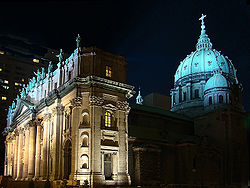
Mary Queen of the World Cathedral in Montreal
cathedral in Montreal on a reduced scale of St. Peters in Rome as an outward
manifestation of his ultramontane beliefs, with the Institut Canadien and the ‘Rouge’ party. The two engaged in a long struggle that came to be known as the Guibord Affair.
- Mid-XIXth
Century Ultramontane beliefs in Quebec
- Power
comes from God, and flows downward to the pope, the Church and then to civil authorities.
In all matters of faith, the Pope is infallible
- Church
and State are united but the State is subordinated to the Church; one is a divine
institution the other is earthly.
- The
Church determines the extent of its jurisdiction, authority and influence. None
may interfere with that.
- They
propound a conservative vision of the world, oppose tolerance, democracy, freedom
of thought and of the press. They also oppose, in the European context, the principle
of nationalities. [See the Syllabus of Errors]
- They refuse
to compromise with the ideas coming out of the French Revolution and with progress.
- They
emphasize duties as opposed to rights.
- They
support Church intervention into politics, so that the ‘true’ principles
will win. They were shocked when legislation to outlaw this ‘undue influence’
in politics was enacted. Their political interference benefitted the Conservative
(‘Bleu’ the colour of heaven) Party and condemned the Liberal Party
(‘Rouge’ the colour of revolutionaries and of hell) to permanent opposition.
- They
stressed an ultramontane form of nationalism (with special emphasis on the three pillars of
survival); nationalism is emptied of political content; they preach the three
myths of agriculturalism, anti-statism and messianism and display xenophobic tendencies. [Consult: Michel BRUNET,
"Trois dominantes de la pensée canadienne-française: l'agriculturisme, l'anti-étatisme et le messianisme" that was published in Écrits du Canada français, Vol. 3, 1957, pp. 33-117.]
- The
United States and France (not the ‘true’ Catholic France!) are seen
as the source of nearly all evils in modern society. [See Pierre SAVARD, Jules-Paul Tardivel, la France et les États-Unis (1851-1905), Québec, Presses de l'Université Laval, 1967, 499p.]
In
this period, the Church gained many privileges in Quebec: full guarantees were
extended to confessional schools; indeed, the only schools permitted in Quebec
were confessional schools; all civil registries were kept by the Church; the only
form of marriage acceptable was a religious marriage and divorces could only be
achieved through an act of the Federal Parliament; Church corporations were not
taxed and the tithe was legally sanctioned. In general, the Church of Quebec controlled
education, health services and charitable institutions. If we consider that the
role of a state is to regulate society and provide to it social services, then
in Quebec in the late XIXth the Church had become, in practice, the State.
[Those who wish to examine further the application of ultramontanism in the context of Quebec - and have the ability to read in French - may consult this bibliography that is available elsewhere at the site. Most of these works are available on the web.]
6. 1896-1960:
The Triumphant ChurchHaving
achieved the pinnacle of its influence and power in the preceding period the Church
sought to ‘sacralized’ or ‘Christianize’ all aspects and classes
of French Canadian society in the next period. In practice, the Church - Sought the training
and renewal of the elite through increasing involvement in the classical colleges
(there were several dozens established in this period, including a number for
women who had been neglected previously). Many associations and movements, addressed
to the elite, were established in this period: among them were the Association
Catholique de la Jeunesse Canadienne-francaise (ACJC), l’École Sociale Populaire,
and the Semaines Sociales du Canada. The French Catholic universities were vastly
expanded to accommodate the elite.
- Promoted
the Christianization of the masses; a vast network of catholic social action groups
were established in the parishes of the province; the Church also assumed the
leadership in the temperance movement. Some parishes were known to have up to
30-40 different pious organizations and parishioners frequently belonged
to several of these at any one time.
- Preached
the Christianization of the socio-economic order. Catholic unions were established
for workers and farmers; there was a catholic chaplain on each of these trade
union locals (Confédération des Travailleurs Catholiques du Canada et l’Union
Catholique des Cultivateurs). They studied the social and economic problems in
the light of Catholic social teachings. The role of the Church was especially
important in the Asbestos strike of 1949. The Church supported and sponsered the
establishment of a large number of cooperatives, especially the Caisses Populaires
which were all organized on the parish basis and with strong clerical support.
- Wished
Christianization through the mass-media. Several Catholic newspapers (collectively
known as ‘la bonne presse’) were established to combat ‘yellow
journalism’. The best known were Le Droit, L’Action Catholique, and
Le Devoir. After initially combating strongly cinema, the Church ran a vast network
of theatres in Church basements.
Clearly it is evident that the Church wielded a great deal of power and influence in this period of time. However, this power did not go uncontested. There remained pockets of radical liberals to champion another vision of the world and fight extreme clericalism. Godfroy Langlois who founded Le Pays, Olivar Asselin who edited Le Canada and established L'Ordre, Jean-Charles Harvey who published Le Jour and Télesphore-Damien Bouchard are good examples of the continuing tradition of protest. As well, the Church was never able to bring the people of Québec to support prohibition despite strenuous efforts to convince the people that it should do so. When the hierarchy supported too openly the British (or Canadian) authorities, it faced both defiance and scorn from the people. Such was the case when the hierarchy supported too openly the war effort of the Canadian government, even in the Second World War. The Church was never able to bring the people to forego attending cinema in the province or to support the campaigns of Achat chez nous. Unconsciously, the people of Quebec resisted clerical control and expressed it in a variety of ways, especially in the widespread use of profanity that is almost entirely directed towards things connected to the Church and religion. [See the entry on Quebec French Profanity and the extensive discussion on the Sacre québécois at Wikipedia; as well, the following articles may be consulted: Josselyne GÉRARD, «Mon ostie de...», Cahier de linguistique, No 8, 1978, pp. 163-179; Guy LAPERRIÈRE, «Un nouvel objet d'étude: le sacre», Recherches sociographiques, Vol. 26, Nos 1-2, 1985, pp. 223-231.]
While
the Church had a good deal of success in integrating the masses, the advent of
the Second World War and the modernization of communications (radio, and especially
television) opened Quebec increasingly to outside influence, and thus to changes.
In any case, the increasing involvement of the Church in all aspects of
the life of French Canadians contained the germs of the demise of Church influence:
the Church was unable to finance all of these institutions and to provide the
personnel to support them. Eventually it was recognized that the State had to
take its responsibilities for the well-being of the province. This would be done
during the Quiet Revolution.
7.
1960-today: The impact of the Quiet RevolutionThe
election of the Liberals of Jean Lesage in 1960 unleashed the floodgates of change.
This change was so sudden and widespread that it received the name of Quiet Revolution.
In this period of modernization of Quebec no institution was to be affected more than
the Roman Catholic Church. Values, ideas and institutions from the past were all
questioned; these had all been anchored by the Church. Language replaced Faith
as the pillar of survival and distinctiveness of Quebec. The State took over schools
and hospitals (all were to eventually be deconfessionalised) and churches nearly
emptied completely. Within ten years Quebec went from being the province with
the highest birthrate in Canada to having the lowest! The society became profoundly
secularized and Church influence fell to nearly nothing. ©
1998 Claude Bélanger, Marianopolis College
|





